Signs the Main Line Is the Problem
One slow drain is a fixture issue. The signs below point at the main line, which is a different and more urgent problem.
Multiple fixtures backing up at the same time
If the toilet backs up when the washing machine drains, or the tub fills when you flush, the blockage is downstream of both. That's the main line. A single clogged sink can't do this.
Gurgling toilets and drains
Air trapped by a partial obstruction has to escape somewhere, and it comes back up through the nearest water trap. A toilet that bubbles when another fixture drains is telling you the main is restricted.
The lowest fixtures back up first
Sewage finds the lowest opening. Floor drains, ground-floor showers, and first-floor toilets overflow before anything upstairs does. If your downstairs shower is where it shows up, the problem is below the house.
Sewage odor indoors or in the yard
A properly sealed drain system is odorless. Smelling sewage means gas is escaping through a crack, a dry trap, or a break in the buried line. Outdoors, a persistent smell over the line's path is a strong indicator.
Unexplained wet spots or unusually green grass
A cracked line leaking into the soil waters and fertilizes the ground above it. A strip of lawn that's greener or spongier than everything around it, running toward the street, follows the pipe.
Active sewage backup inside the house? Stop running water at every fixture, avoid contact with the water, and call 346-671-0767. Every gallon you send down the drain makes the backup worse.
What Actually Fails
Root intrusion. Tree roots follow moisture. They enter through joints and hairline cracks as fine hairs, then thicken inside the pipe until they form a net that catches everything passing through. Roots don't just block the line, they widen the opening they came through.
Bellies. A section of pipe that has settled below grade holds standing water instead of draining. Solids settle out in the low spot and accumulate. Cleaning a belly relieves the symptom; the belly stays until the pipe is re-graded.
Offset joints. Ground movement shifts one length of pipe out of alignment with the next. The resulting ledge catches debris and lets soil and water in.
Cracked or collapsed pipe. Age, shifting soil, or heavy loads above can crack a line outright. Clay and older cast iron are the usual candidates. A full collapse stops flow completely.
Corrosion and scale in cast iron. Cast iron drain lines scale from the inside as they age, roughening the wall and reducing the effective diameter until the line no longer carries what it was sized for.
Grease and non-flushables. Grease cools and solidifies on the pipe wall. Wipes marketed as flushable don't break down. Together they build a restriction that catches everything else.
Which of these you are dealing with is a camera question, not a guessing question. Roots and a belly produce almost identical symptoms from inside the house, and they call for completely different repairs — which is the whole argument for looking before digging.
The age of the house is the best clue to what the line is made of, and the material largely decides how it fails. Mention the build era when you call.
Diagnosis: Camera First
Repairing a sewer line without seeing inside it is guesswork, and the guess is expensive when it's wrong.
Clear enough flow to see
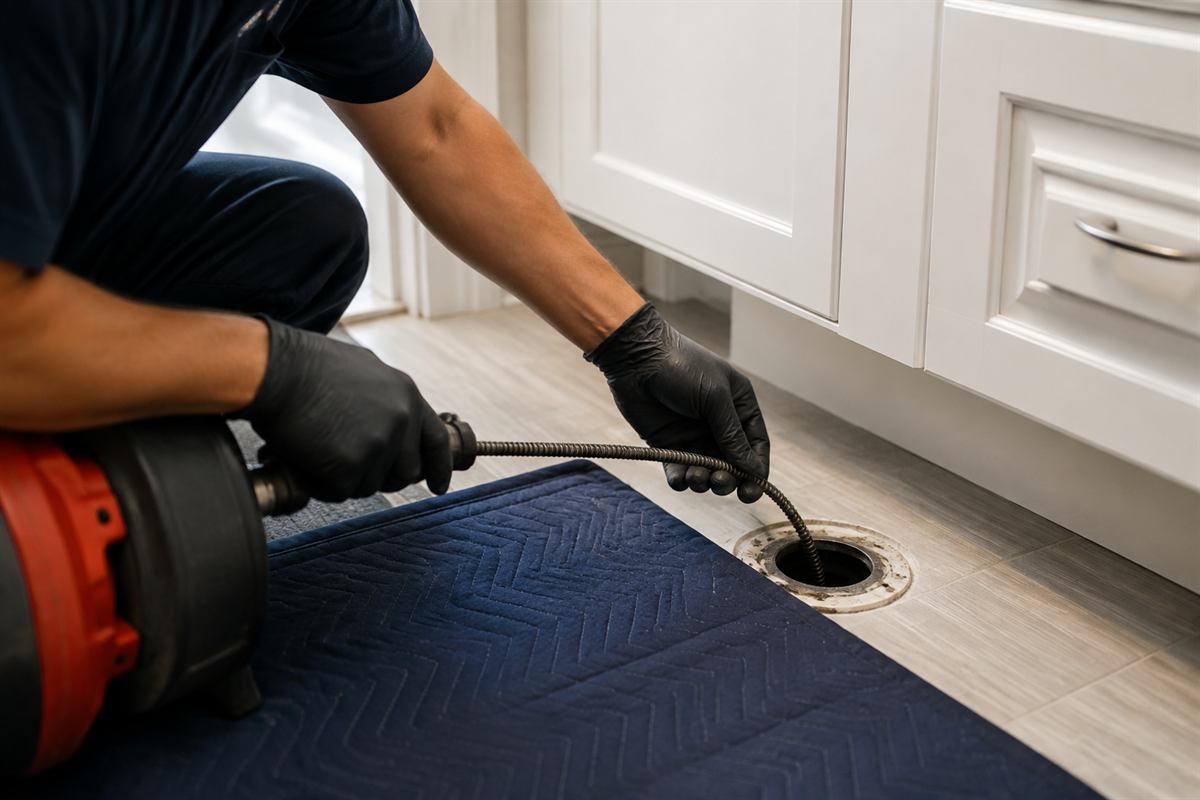
A completely blocked line has to be opened before a camera can travel it. That's usually a cable machine or hydro jetting — not the repair, just enough to get a look.
Run the camera
A self-leveling camera on a push rod travels from the cleanout toward the city connection, recording the whole run. You should be shown the footage and told what you're looking at: the material, the condition, and the specific defect.
Locate and measure
A transmitter in the camera head lets a receiver at the surface mark the exact position and depth of the defect. That's how a repair gets scoped to a few feet of excavation instead of a trench across the whole yard.
Decide the method
Depth, material, defect type, and what sits above the line — driveway, mature trees, patio — determine whether the fix is dug, lined, or burst. Ask to see the footage that supports the recommendation.
Repair Methods
Cleaning is not repair
Cabling cuts through a blockage. Hydro jetting scours the pipe wall with high-pressure water and removes grease and scale properly. Both restore flow. Neither fixes a crack, a belly, or an offset joint — if roots came back through a joint once, they will again. Cleaning is the right first step and the wrong last step.
Spot repair (open cut)
Excavate at the located defect, cut out the bad section, install new pipe, backfill. Straightforward and the least expensive when the rest of the line is sound and the defect is shallow and accessible. The cost driver is what's on top: lawn is cheap, a driveway is not.
Full replacement
When a line has multiple failures, a significant belly, or has reached the end of its material life, replacing the whole run costs less than repairing it three times. Grade gets corrected in the process, which a lining repair cannot do.
Trenchless: lining and bursting
Cured-in-place lining pulls a resin-saturated liner through the existing pipe and cures it to form a new pipe inside the old one. Pipe bursting pulls a splitting head through, fracturing the old pipe outward while drawing new pipe in behind it. Both avoid a full-length trench, which matters when the line runs under a driveway or established landscaping. Neither works in every situation — a collapsed line or a severe belly generally rules lining out.
Some specialist trenchless work is handled by a subcontractor with the right equipment for it. That is normal and it does not change who is accountable — the plumber who quotes your job stays responsible for it. Ask when you book which method suits your line and who will be carrying it out.
What Sewer Repair Costs
The range is wide because the variables are wide: length of the run, depth, pipe material, what's above it, and whether the city connection is involved.
Depth is the single biggest driver. A line two feet down is a different job from one at eight, and the difference is not linear — deeper means shoring, more spoil, and more time. After that it is the length of the run and what is sitting on top of it.
Lawn is cheap to open and put back. A driveway, a patio or a mature tree is not, and that is often what pushes a job toward trenchless even though trenchless costs more per foot than digging. Whether the city connection is involved changes the picture again.
Whether the camera inspection is billed separately is covered when you book the appointment.
One thing worth establishing early: the line on your property is normally yours to maintain, while the portion in the public right-of-way may fall to the utility. Where exactly that boundary sits differs between jurisdictions, and your service area covers several. If the defect is located near the street, your plumber will tell you which side of the line it is on and who you need to be talking to — before you pay for work that was not yours to pay for.
Keeping It From Happening Again
- Grease goes in the trash, not the drain, even chased with hot water
- Nothing flushed but waste and toilet paper — "flushable" wipes are not
- Know where your cleanout is before you need it
- If roots were the cause, expect them back; plan on periodic inspection or address the tree
- Get a camera inspection before buying a house with mature trees and an older sewer line
Sewer Line Questions
How do I know if it's the main line or just one drain?
If more than one fixture is affected at the same time — especially fixtures in different rooms — the problem is in the shared line downstream of both. If it's one sink and everything else drains normally, it's local to that fixture.
Do I need a camera inspection, or can you just snake it?
Snaking will usually restore flow, and if this is a one-off blockage that may be all you need. If it's the second backup in a year, snaking again without looking is treating a symptom. The camera tells you whether something structural is causing the repeats.
Will my yard be destroyed?
Not necessarily. A located spot repair opens a small area over the defect. Trenchless lining and bursting need access pits at each end rather than a full trench. Full open-cut replacement is the most disruptive option and it isn't always the required one.
Are tree roots my neighbor's responsibility?
Roots entering your line are your line's problem regardless of which yard the tree stands in. Whether you have any recourse against a neighbor is a legal question, not a plumbing one.
Do I need a permit for sewer line work?
Usually. Sewer repair and replacement is typically permitted and inspected work, and anything touching the city connection or the right-of-way brings the utility into it as well. Your plumber will confirm what your job requires, who pulls the permit, and whether an inspection has to be scheduled.
Request Sewer Line Service
Describe what's backing up and we'll call you back. If sewage is coming up inside the house right now, call 346-671-0767 instead.
Prefer to talk? Call 346-671-0767.